Ocean Mother
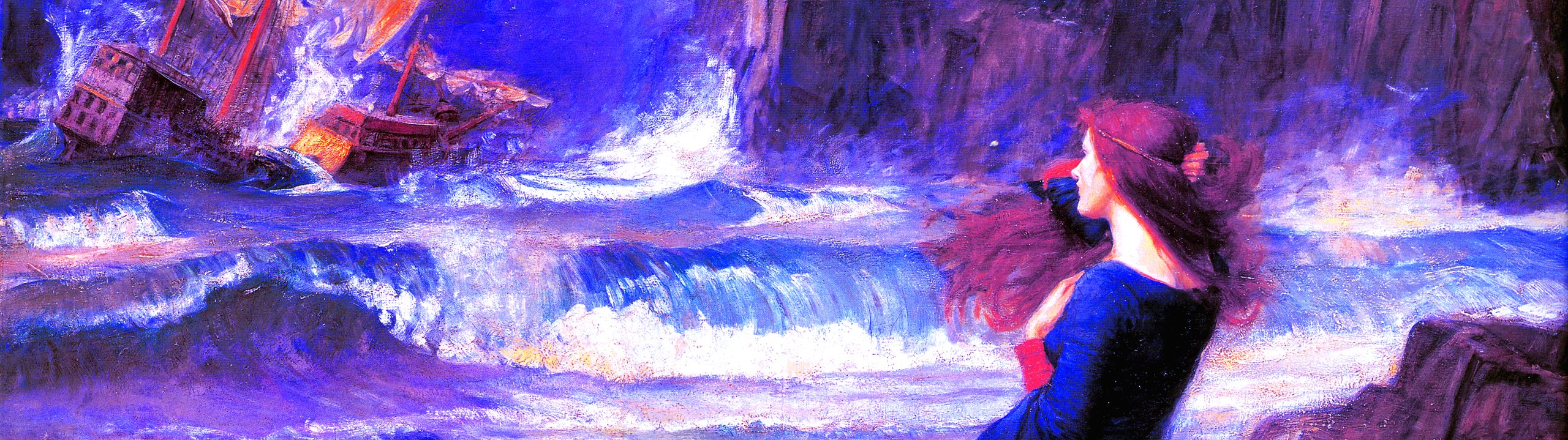
The theological structure of Undinic Craft is a two tier system with Ocean Mother at the top and beneath her are all the feminine water deities and spirits that hold different names, construction, and features found in various cultures. While these particular deities have their own identified qualities and mythologies, Ocean Mother is an overarching and mysterious goddess that dwells within the deepest parts of the ocean. She is the aquatic principle of The Great Goddess and is mother of all the undines. She is the queen of all queens and is the embodiment of the grace, severity, elegance, tenacity, and sublime truths of the element of Water.
Ocean Mother is evoked in every Maelstrom with a lit blue candle representing Her presence. She has a specific rite that is performed at every blue moon that is called The Blue Moon Festival, the contents of which are oathbound.
The Procession of the 12 Queens
Her daughters, the water deities or spirits, are referred to as “The Aquatic Queens” and each Lead Siren will select 12 for their Cove to hold a celebration for each month. The selection of the 12 is personal and takes time and consideration to find the ones they can form a relationship with that they feel hold a desire to be a part of their Cove and a part of the Undinic Craft as a whole, and that each one exemplifies different features of Water and stories that can guide their Sirens as they learn the Craft and ultimately learn about themselves and their relationship to Water.
The Procession of the 12 Queens is a monthly celebratory ritual that involves a recital of a play that tells the story of each Queen. The purpose of this is to incite a drama that each Siren can experience on a deep level and learn from their tales to help them in their understanding of Water and the nature of the Undines. The choice for which entity is celebrated in which month may be random, personal, cultural, or historical. Offerings of food, drink, incense, and other gifts that are known to appeal to each Aquatic Queen are placed upon the altar, the food and drink being shared among the sirens during the celebration with the best portion set aside for the Aquatic Queen first.
One thing to keep in mind when one selects their 12 Queens is that they are not guaranteed that the deity or spirit in question wants to be a part of the practice itself. This conclusion is difficult to conceive of and may even be hotly debated based on each Undinic Witch’s individual experience. An additional consideration is that the deity or spirit in question may accept and even enjoy being revered within the rituals of an Undinic Maelstrom, but may conclude that a relationship with the Lead Siren of a particular Cove is not a working situation. The conclusions are rarely obvious and are up to the discretion of the Lead Siren and no one else.
Additionally, another thing to be aware of is that some of these deities or spirits still hold functioning traditions. The important thing to remember when it comes to these entities is that when they are celebrated, it is under the context of an Undinic ritual. There is no claim to any particular entity, no matter the personal ancestral bond a Lead Siren may hold with said entity. The Aquatic Queens are honorary guests within the Maelstrom and the purpose of their celebrations is to learn from their stories and to offer respect and reverence. No ritual of a living tradition should be practiced within the Maelstrom, even if the Lead Siren is an initiate of that particular tradition.
The following is a short list of potential deities and spirits that an Undinic Witch may choose to hold celebrations for. There are countless other deities and spirits with particular names, features, and origins and each Undinic Witch is encouraged to do their own journey of discovery in order to be exposed to a variety of ways we as humans relate to and interpret Water.
Amphitrite
A Greek goddess of the seas and one of the 50 Nereids (or sea nymphs), she was the consort of the sea god Poseidon. So enchanted by her beauty, Poseidon desired her and wanted to make her his wife. Wishing to protect her virginity, she escaped to the Atlas Mountains and in pursuit of her, Poseidon sent a dolphin to persuade her to accept his proposal. Upon success, Poseidon thanked the dolphin by creating a constellation in the sky called Delphanius. She had her own dedicated cult and they did not see her as a simple consort, but a powerful goddess that had authority over the sea before becoming Poseidon’s wife.
Anahita
An Iranian goddess of the Zoroastrian religion, she is the embodiment of the mythical life-giving river of Aredvi Sura Anahita that poured forth from the tall mountain of Hara Berezaiti, associating her with fertility and abundance of the lands as well as wisdom. Her veneration was highly valued and she is still honored by practicing Zoroastrians today.
Anuket
An Ancient Egyptian goddess, she was a ruler of the Nile who supplied the floods that would result in the fertile black lands of then Kemet. She was considered a nourisher for this reason, but also “the embracer” as she is sometimes depicted with outstretched arms that are symbolic of the two tributaries of the Nile.
Aphrodite
A Greek goddess, she is known as being the goddess of love and sex, carrying with her a long line of ancestors that she derived from, many of them in this list. Her relation to the sea is simple: she was born from it. In a cosmic battle between Uranus, god of the skies, and Cronos, god of time, Cronos castrated Uranus and his member fell into the sea. The sloshing waves mixed the blood and ejaculate from his detached phallus and created a foam upon the shores and the foam formed into the Greek goddess of love.
Ashera
A Canaanite goddess that was considered the mother of all the gods of the Canaanites, she was the consort of the supreme god El, with some scholars arguing that she was later considered the consort and feminine principle of the Abrahamic god Yahweh before being excised from the scriptures completely. She has many features but is considered to primarily be a goddess of the sea.
Astghik
An Armenian goddess whose name means “little star,” she was a goddess of love and fertility. She was a creator of the heavens and the earth and highly associated with water. A myth that follows her is that she would bathe in a nearby stream and the villagers would come to spy on her and her beauty. Annoyed with this, she manifested a thick fog to protect her privacy and the fog subsists today and the place where she was suspected to bathe was called Msho Dasht, deriving from the Armenian word for fog.
Atabey
A goddess of the Taino people of Puerto Rico, she was a goddess of all waters level. She was the mother of the god of order and the god of chaos, the two most primordial principles of the universe. She is a goddess of balance and is often portrayed as being quite frog like, the tiny coqui frog being sacred to her. The chirp of the frog comes in two pitches: low then high. The low chirp wards off potential rivals while the high chirp draws in potential mates, embodying the two different natures found within her dualistic sons.
Atargatis
She is a Syrian goddess that may have been one of the first iterations of a mermaid: upper body of a woman with the tail of a fish. After falling in love with a humble shepherd, she consorted with him and conceived of a child. Breaking the taboo of deity/human relationships, she reluctantly slays her lover, abandons her daughter, and throws herself into the waters where she becomes the fish/hominid hybrid. Interestingly, her daughter became associated with the legendary Semiramis: a fierce and beloved Assyrian queen. Atargatis was vastly loved and worshipped and her temples held pools of water with fish that were cared for by devotees and never eaten.
Boann
An Irish Celtic goddess associated with the River Boyne, her story is that of bravery and the pursuit of sacred knowledge. The Well of Segais held such sacred knowledge and she couldn’t resist. It was surrounded by nine hazelnut trees and red hazelnuts would drop into the well, enriching its waters with knowledge. She committed the taboo of walking around the well widdershins in order to acquire its sacred truths and the waters swelled and burst from the well, washing her away and making her become the River Boyne. Now, being one with the waters, she is steeped in the gnosis that she longed for.
Chalchiuitlicue
An Aztec goddess, she is purveyor of all waters and oversaw fertility, particularly that of women. In the Aztec mythological structure of eras referred to as the “Five Suns,” she ruled over the Fourth Sun, releasing decades of rain. She manifested a rainbow bridge from the earth to the heavens where those who took the trek would cross safely if she approved of them, but would fall from the bridge and turn into fish if she did not.
Eingana
An Australian Aboriginal goddess, she is represented as a winged rainbow serpent and is considered the creator of the world, manifesting through dreams. Her slithering on the earth created the rivers and where she rests coiled created the billabongs. She holds a tether to all living things and if the tether breaks, they will perish.
Mama Qucha
An Incan goddess, she embodies all and every type of body of water. She protected seafarers and provided abundance of fish from the seas. She was also said to be sent to humankind to teach them agriculture and how to live in peace and harmony with the earth and with each other.
Mazu
A sacred spirit that is revered in Chinese folk religion and Taoism, she is actually based on a historical figure, Lin Moniang, who was considered a shamaness and prognosticator. One of her legends was that when she was a girl, her father and brothers went out into the seas to fish and while they were gone, she had a dream where they were caught in a terrible storm and she managed to stretch out her arms to save her father and two of her brothers, but her mother awoke her before she could save the last brother. When they returned, the storm she had dreamed about really did occur and the brother she could not save was tragically lost to the sea. After her death, she was honored and beseeched as a guardian and protector of the sea and seafarers.
Medusa
A Greek monster, she was one of the three Gorgons: beastly women with snakes in their hair, wings, and tusks. Their likeness was carved as reliefs on temple walls as a means of protection. In the telling of early Greek poets of the myth of Medusa, she was a fair mortal maiden who was a priestess of Athena. In Athena’s temple one evening, she was raped by Poseidon. (contextual note: the word rape in this time often meant the taking of female human property, in this case Athena’s, and consent was not a feature of the term, although consent was not something that was seriously considered in general at the time.) Furious with her virginity being taken, and her oath of never consorting with men being broken, Athena cursed her with snakes for hair and the uncontrollable ability to turn those into stone who gaze into her eyes. She was then exiled from the temple to live in ruins next to the sea where she was ultimately slain by the Greek hero Perseus.
Melusine
A sweet water fairy, Melusine had a rich and impactful history. She was considered to be the founder of the House of Lusignan in Putois, France. A beautiful woman six days of the week, she turns into a strange aquatic creature on Saturdays where her lower half transforms into a snake tail, a fish tail, or a split fish tail. Crossing her path and taken by her beauty, Count Raymondin begged for her hand in marriage. She agreed so long as she was left alone in her toilette and be completely unseen on Saturdays. The count agreed and they led a happy marriage and she bore him ten sons while founding his house. But his oath was eventually broken and she transformed into a dragon and flew away, only to return 3 days before a descendant of the house was to perish, flying around the castle and crying out.
Ran
A Norse goddess and wife of the sea god AEgir, they both personify the sea. With her treacherous net, she captures seafarers and drags them into the depths. Many sailors would carry gold with them to offer to her so that instead of a perilous death, she would instead take them to the underwater hall of delights where she and her husband dwelled.
Sedna
An Inuit goddess, she is the mother of all sea creatures, particularly mammals. She was once a simple girl who denied all marriage proposals. Her father, seeking to find a suitable husband for his perceived rebellious daughter, struck a deal with a very successful hunter. The hunter gave him a potion to give to Sedna to put her to sleep and then deliver her to the hunter by crossing the waters in a boat to his fortress. Once in the hunter’s possession and after her father departed, the hunter revealed himself to be a frightening bird spirit. She called for her father in terror, who returned to rescue her in his boat. The bird spirit flapped his wings to create fierce winds and violent waves. Fearing the boat would capsize, her father tried to throw her overboard in order to return her to the bird spirit. She held on to the side of the boat and in response, her father cut her fingers off after which she fell into the water and deliberately allowed herself to sink instead of submitting to being the bird spirit’s bride. Her severed fingers transformed into creatures of the sea who became her companions. She was depicted with the upper body of a woman with the tail of a seal or a whale.
Thalassa
A Greek primordial goddess of the sea, she represents the deep brackish waters at the beginning of time. She appears with grey hair, crab claws for horns, and is wrapped in seaweed. In a fable by Aesop, a seafarer laments the destruction of his ship and blames the perilous waters. Thalassa appears and insists that her waters are calm and placid, and that the powerful winds of the sky are to blame for the massive waves that caused the shipwreck, highlighting an interesting interplay between the powers of Air in relation to Water.
Tiamat
An ancient Babylonian primordial goddess of salt water, chaos and mother to all gods, she is associated with the oceans and with dragons. She and her consort, Abzu, god of sweet water, became irritated with their noisy children and sought to punish them. One of the children slays Abzu and Tiamat sends monsters to defeat them in retaliation. Another of her children eventually slays her and uses her body parts to create different parts of the world.
Yemoja
A major Orisha of the Yoruba religion of the Yoruba people in Western Africa, she is considered the mother of all and the waters of the land burst forth from her womb. Her veneration made its way to the New World due to the Trans-Atlantic slave trade and she is still actively honored in traditions such as Candomble in Brazil, Santeria in Cuba, and Vodou in Haiti and the state of Louisiana in the USA. She is a gentle motherly spirit, but also a fierce protector of women and children.