
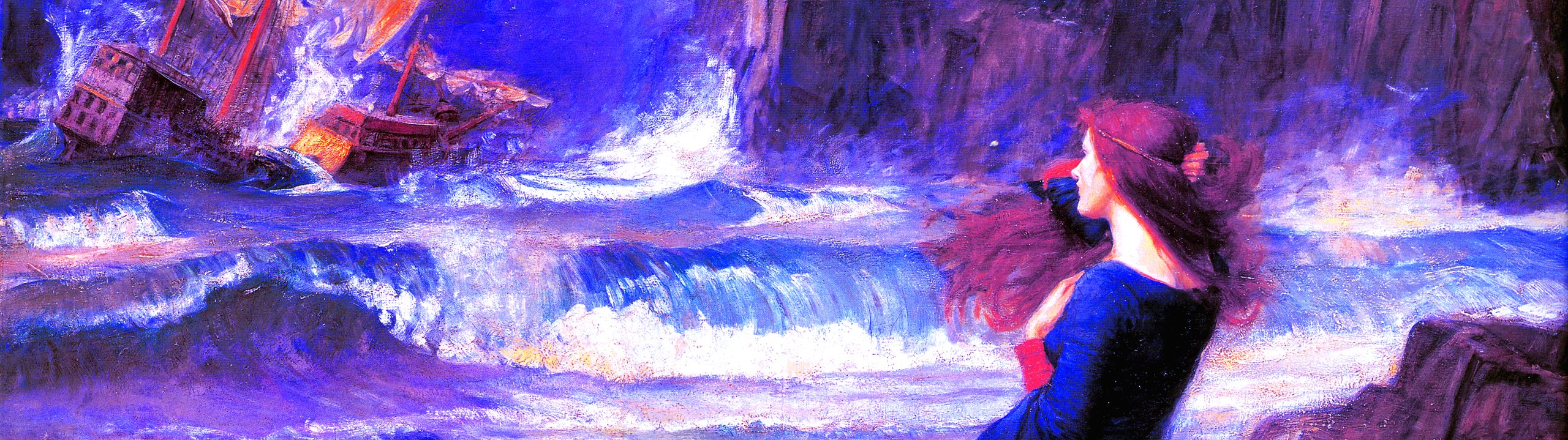
Each of the four alchemical elements: air, fire, water, and earth, consists of ethereal creatures that are called elementals. These beings consist only of their respective element while all other living beings possess all four. The earth is all the solids of our body, water soaks every aspect, air courses through our blood, and fire exists in the warmth of all its parts.
Since the elementals are only comprised of one aspect of each of the states of matter, it is difficult to actually see them, but many think it’s possible. Paracelsus, an alchemist of the early modern period who did extensive musing on elementals wrote: “…describe the creatures that are outside the cognizance of the light of nature, how they are to be understood, what marvelous works God has created.”
What do Undines look like? They are contemporaneously depicted as mermaids: lovely women with the lower half of a fish tail, but they were originally thought of as water nymphs or fairies, not necessarily having the appearance of a human/animal hybrid. They are often seen as alluring, usually devastatingly so.
In stories of old, the enchanting melody and captivating beauty of a mermaid, appearing as a maiden with her fish tail hidden just beneath the waves, would lure unwary sailors to their doom. Often, the penalty for succumbing to her allure was death, serving as a cautionary tale against the dangers of irresistible temptations that mask perilous consequences.
Mermaids were often seen as vain: with a comb to brush their wet, salty locks and a mirror to gaze upon their exquisite visage. This stereotype mirrors a persistent cultural suspicion directed at beautiful women: that desirability inherently implies manipulation and a desire to exploit vulnerable men. Yet, not all aquatic mythical figures share this fate. Melusine, the sweet-water fairy, endures in legend as the revered matriarch of the House of Lusignan. Moreover, she is frequently invoked as an unofficial patron saint by those living with physical differences. This association stems from her own lineage, as unions between fairies and mortals often yielded children with unique physical traits, a legacy reflected in her ten sons, each of whom was born with a distinct malformation.
In Hans Christian Andersen’s classic fairy tale, The Little Mermaid, the innocent sea-dweller sacrifices her comfort to cross new horizons and live on land, only to have her dreams ultimately dashed. This narrative brilliantly subverts traditional mermaid lore, casting the mythical sea creature as the tragic victim of her own mortal longings. Perhaps some Undines, too, harbor secret wishes to become human and experience the mortal touch.
Even the very first mermaid gave into her desires for humankind. The Syrian goddess Atargatis longed for a humble shepherd, but she had crossed the taboo of divine beings cavorting with mortals. She reluctantly killed her lover and punished herself by leaping into the ocean’s depths where she transformed into half woman, half fish. But she was beloved in her time, linked strongly with Goddesses like Inanna and Astarte and had a powerfully dedicated cult. Her daughter, sired by the shepherd, became the legend of an existing fierce warrior queen: one of the most powerful female leaders in antiquity.
Mermaids themselves have a rich history, but how are they linked with Undines? Paracelsus gave the water elementals this name which came from the Latin “unda” meaning “wave” with the diminutive “-ina” which in Italian is added to words to categorize them as “little.” Undines are little waves and the waves are the children of Ocean Mother.
There are many races of aquatic females that can be seen in multiple ancient civilizations. In Greece, there were three classifications of these types of ladies: Naiads (fresh water nymphs), Nereids (sea nymphs, particularly of the Mediterranean), and Oceanids (nymphs of the primordial waters) all of which were daughters of mighty aquatic deities. The Rusulka are Slavic water spirits, typically tied to lakes and rivers. Selkies, of Scottish and Irish folklore, are seals living in the oceans, but can shed their skin and become lovely women. Sirens are Greek water spirits having the head or upper body of a woman and the hind quarters and wings of a bird. Their song drives men to madness where they will sail their ships into the rocky terrain in which the sirens live. In the age of classical Greece, sirens began to be artistically depicted as mermaids.
Paracelsus had a specific view of undines that he gleaned from folklore. He classified undines as “beautiful women,” not really focusing on the idea of them being mermaids or otherwise human/animal hybrids. But what does “beautiful” mean within the undinic context? The standards for beauty are ever changing, even decade to decade. In the 2020s, a more curvaceous body with a focus on wide hips with an ample bottom and darker features are the desired goal. Just ten years ago, waif-like bodies with pronounced bosoms and golden hair was considered the ideal. What were the standards of beauty in Paracelsus’s time and does that reflect on how we see undines today? When they take form, do their bodies hold the same beauty that enchanted the fellows of yore? Perhaps their beauty is not timeless, but in fact an avenue in which they enchant humans whom they seem to have a great interest in. In Paracelsus’s assessment, he proclaimed that undines were not immortal beings and when they parish, their consciousness ceases to exist and instead return to the waters. However, given aid of the physicality of water, they can materialize into real humanoid beings. Upon this incarnation, they are eligible to cavort with humans and even marry them. Once they are in devotional union with a man, they gain a soul and their consciousness can live on after expiration, much like humans.
This would explain the persistent existence of Melusine, continuing to be honored by the descendants of the House of Lusignan and the reverence those of surrounding areas have bestowed upon her. And of course, we can’t forget her prevalence in capitalism as the official mascot for Starbucks. That being said, she permeates all spaces and she follows you everywhere you go, latte aficionado or not.
It’s an interesting take to suggest that these lovely female creatures must rely on a man to assure their longevity. In the advent of feminism and women given the space to realize their power, the necessity of being under the auspices of a man is a thing of the past, and yet the undines still call for us. That is why we are specifically a sisterhood: to break the taboo of feminine union and release them of the necessity of civil and reproductive servitude in order to grant them the gift of eternity.
We unite with and serve them. By pure virtue of their existence alone to shine upon us and transform us with the grace that is their nature, we have already indulged in their gifts ten-fold. Our devotion to them resulting in the assurance of their longevity is the reciprocity we offer.
Blessed are the Undines. Their unparalleled beauty and the shining luster of their essence is the lifeblood of our craft. We delight in what they delight. We embrace what they embrace. We love as they love. Our spirits bloom as the blue lotus as we ebb and flow together.